NoiseAtlas.
Making noise and light pollution easier to see, measure, and understand.
An independently developed environmental monitoring project, from an early noise-and-light sensing prototype to distributed acoustic monitoring and sound recognition. NoiseAtlas connects calibrated microphones, wireless sensor nodes, cloud storage, and a web application.
Make the environment measurable
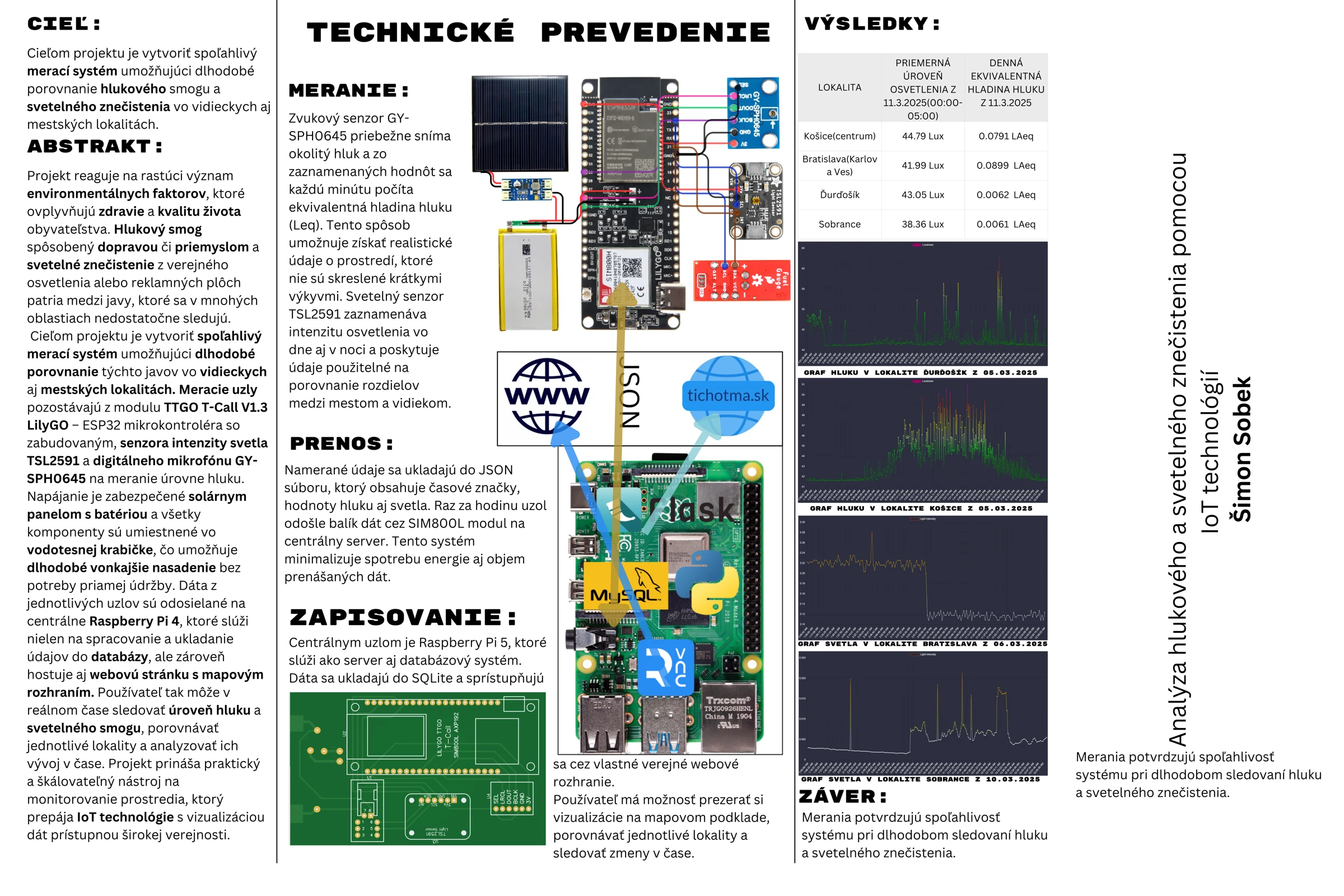
Noise and artificial light are easy to notice but harder to describe consistently. Originally presented as “Ticho a tma v ohrození”, the project began with measuring both forms of pollution and making the observations available for analysis.
From a prototype to distributed sensing
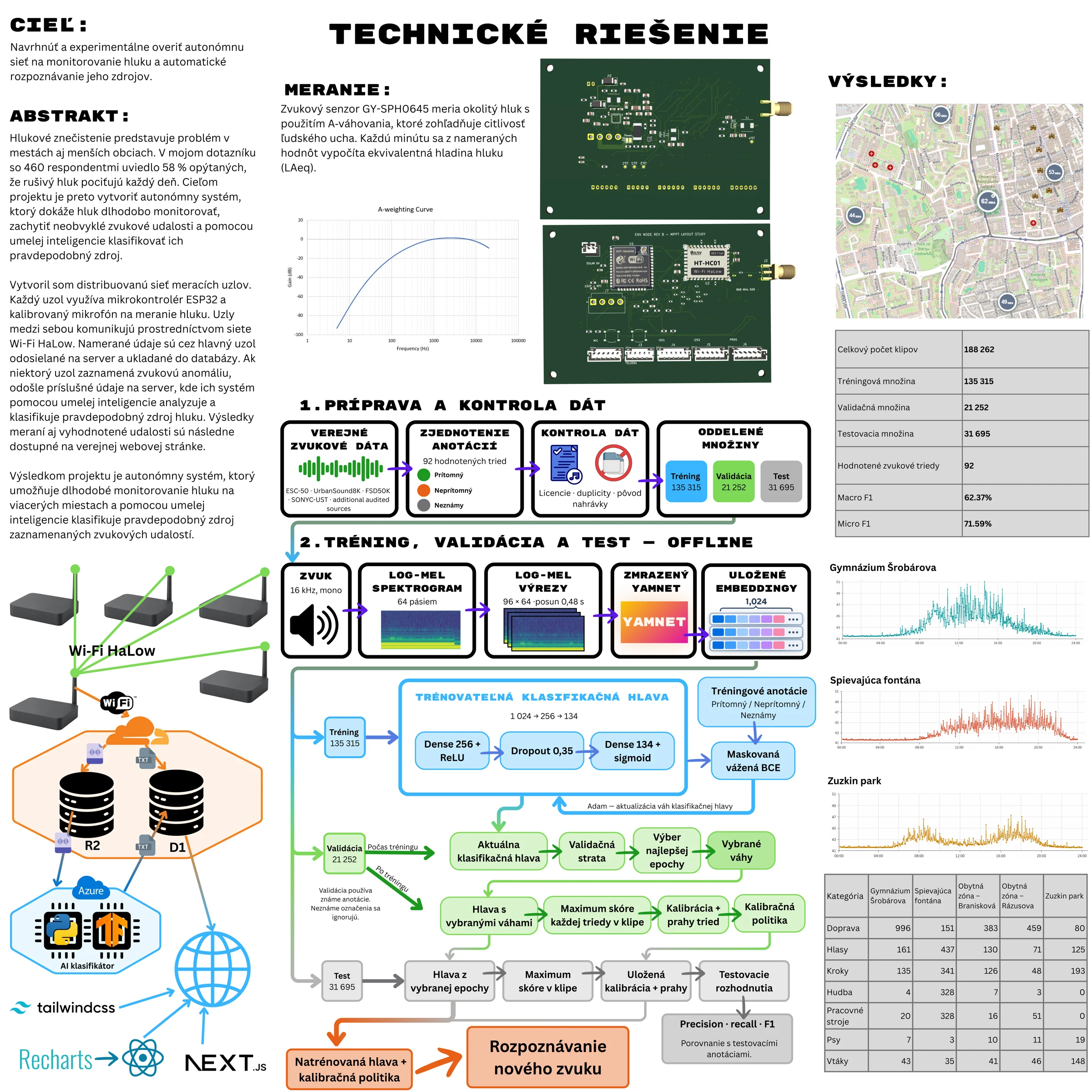
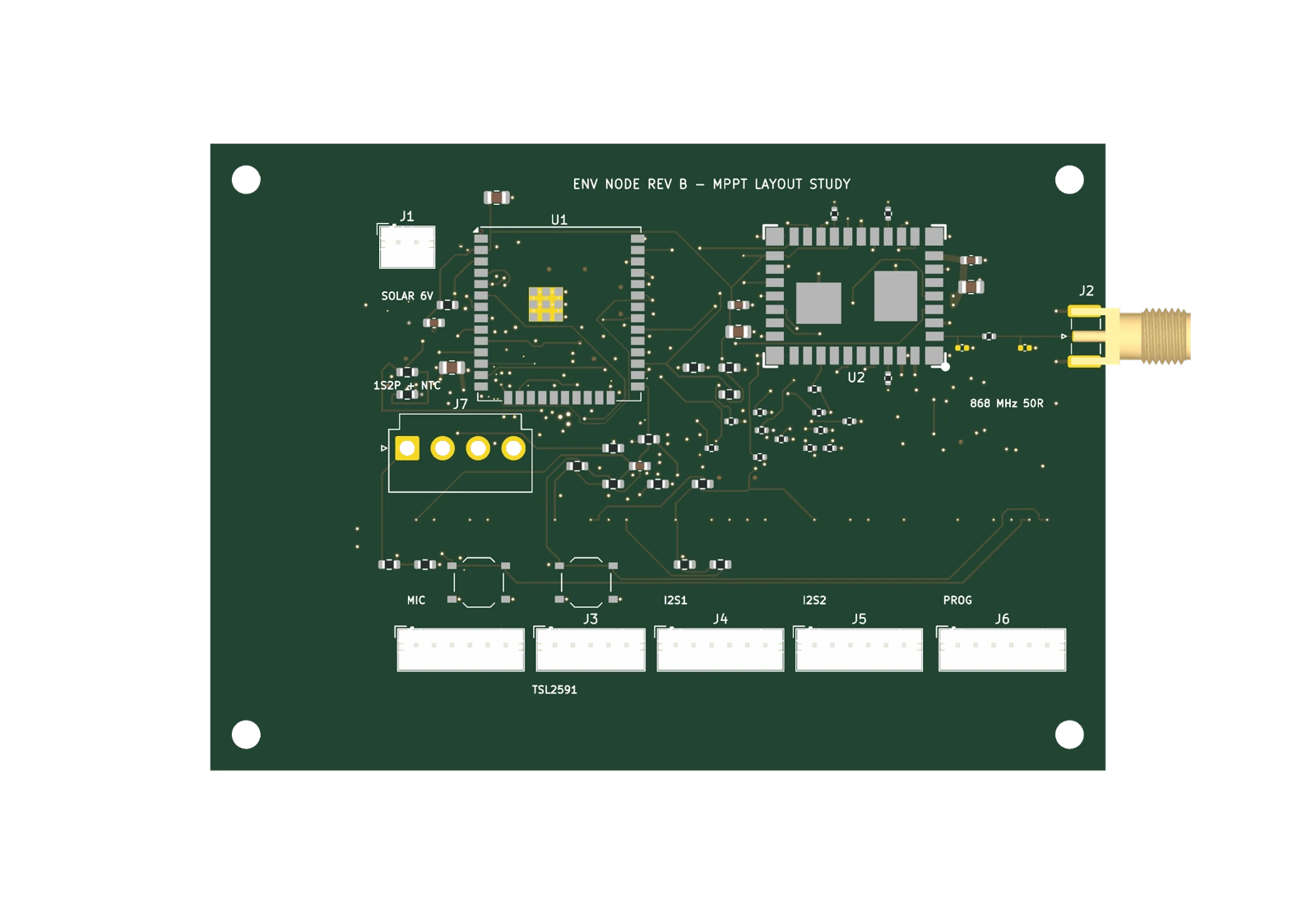
An earlier prototype explored Raspberry Pi, solar power, and a SIM800L cellular connection. The later monitoring design uses distributed ESP32 nodes with calibrated microphones, connected through Wi-Fi HaLow to a main node for uplink.
Measure, store, and visualise
The acoustic pipeline produces one-minute A-weighted equivalent sound levels (LAeq). Cloudflare D1 stores measurements, while R2 stores anomaly audio clips. A React and TypeScript web application connects the collected data with visual exploration.
Recognise the sounds behind the levels
A Python and TensorFlow classifier on Azure adds sound recognition to the measurement pipeline. It uses frozen YAMNet embeddings with 1,024 features and a trained classification head, connecting acoustic events with information beyond a sound-level reading.
Evaluate the model separately
The project poster reports a training dataset of 188,262 audio clips and an offline evaluation across 92 classes: macro F1 of 62.37% and micro F1 of 71.59%. These are reported evaluation results; they do not describe live deployment accuracy.
Along the way
- 3rd place · Regional SOČ, Informatics · 2025
- Dean’s Award · Faculty of Science, UPJŠ student scientific conference · 2025
- Qualified for the national AMAVET Festival of Science and Technology · 2025
Behind the build.
Two snapshots of the research: the environmental sensing prototype and the sound recognition system. Figures and evaluation results belong to the work presented in each poster.